



In the third and final part of the event which came together on February 10th, 2026, the first Cùra Guardian Online event bringing together several of the global contributors, the spotlight was on Don Rowlands, joining from Birdsville in Queensland, Australia and Hana Shono, joining from Tokyo, Japan.

‘Globalisation’, the Feature Story on Cura Guardian, is one which strongly resonated with Don Rowlands, He is the Head Ranger at Munga Thirri National Park, Simpson Desert in Queensland but he is also an Aboriginal Elder, one of the keepers of the Dreamtime stories and one of the people whose predecessors were deeply impacted by what happened with the arrival of the first European settlers.
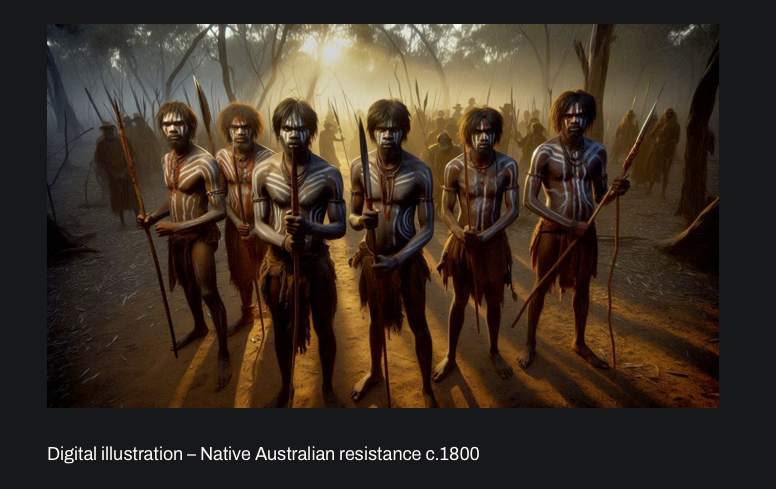 That impact has been felt right upto the present time, including Don’s own childhood and upbringing, and only just starting to be put right to some degree. As part of that process, Don is sharing Dreamtime stories with Cùra Guardian to ensure this vast knowledge, an incredible orally told resource which has so much value for all today, is shared globally, something all of us in Cùra Guardian feel is a great honour.
Interviewer: Sitakumari, Director of Heartstone
Sitakumari
Welcome Don, I know it is very early for you and thank you for being part of this special event. Can you please start by telling us a bit about yourself.
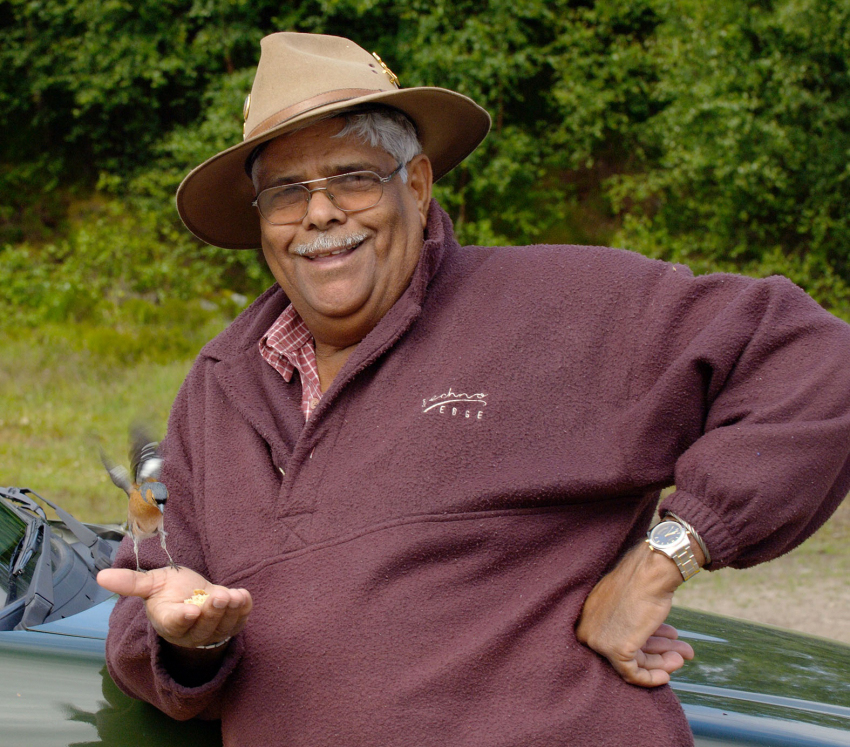 Photograph left: Don Rowlands pictured in the Scottish Highlands when Heartstone arranged a visit for him several years ago. You can see even here his remarkable ability with animals is not restricted to Australia- the bird was very happy to land on his hand!
Donald Rowlands
Good morning everyone. Happy to hear all those stories and how so similar they are and the fight goes on. And I agree with one of the ladies. We should try and meet some time somewhere and have a big corroboree!
Just a bit more about me. I live in Birdville, Queensland, almost in the centre of Australia in the driest part of the whole nation, and our rainfall is 125 mls. You can see that’s not enough, but it’s what we get. I first started in national parks back in 1994, so about 32 years as of the 31st of January 2026. I still enjoy everything about what I do, looking after and protecting. That is the best part of my job. And all those creatures, big, small, and otherwise, all rely on us and people like us to look after them and care for them. It’s a privilege to do this work. And like I said, for 30 years, I’ve really enjoyed my work in Munga Thirri Desert.
Sita Kumari
Can you tell us about the Dreamtime stories and why they’re so important to you and what you’re trying to do?
Donald Rowlands
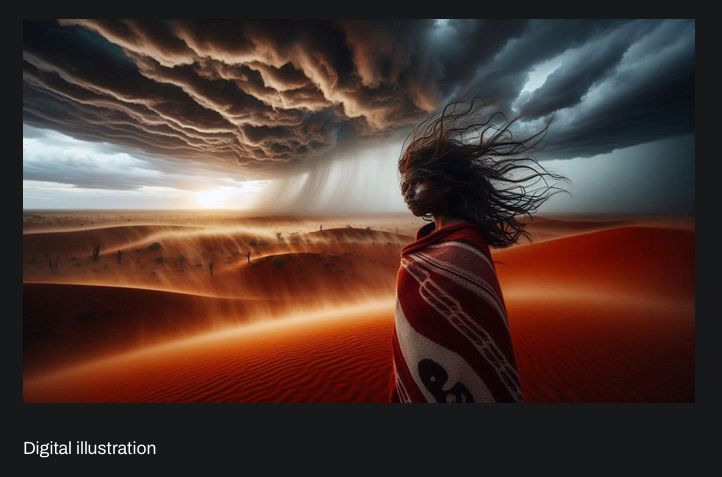
Thanks for the question. I have listened to everyone this morning and gee whiz, how wonderful and so similar they are, you know. But these stories guide my work in Munga Thirri in a very real and practical way. They aren’t just tales from the old people – they’re maps, they’re warnings, instructions, and the history all rolled in to one. Old stories crisscross the desert. And just like the song lines themselves, by following them, I understand how the land fits together. Song lines are very important for our people. A lot of people today explained how the stars and nature itself, basically help people find their way through this country. It’s very vast, it’s the biggest desert in the world and it’s dangerous, but our people survived for, you know, 60,000 years.
Sita Kumari
One of the stories you gave us, the birth of the Mathapurda Pula, is about ‘finding the way’. It’s a very dark story isn’t it.
Donald Rowlands
Yes, it is. But just bear in mind that our stories have to be cruel, they have to be especially bad, so that we keep that memory. We tend to remember the horrible things, the bad things more than we do the good things, so this is why the stories are so selfish sometimes, and it’s a way for people to appreciate the land and the country, especially my people. And without this story, you know, a lot of people could and may, you know, die as a result of the mistakes they make.
Sita Kumari
The story is about betrayal and selfishness and it’s horrendous, but in the end it leads to something good.
Donald Rowlands
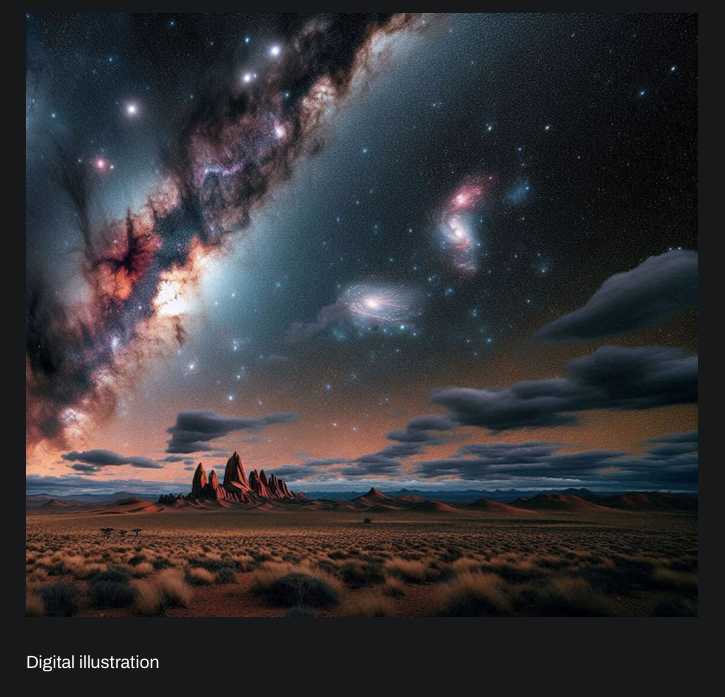
Yes, it does. It’s about the stars in the sky, the Magellan clouds. It is the two old men that did this bad thing and the whirlwind picked them up and bounced them all over the country. Every time they hit the ground, they created a water source, and so when it rains, those little places are filled with water. We call them gilgais.
It’s a terrible story, but, like I said, it’s about us remembering the story, but just by knowing that it was a really bad situation, but in the end, it leads to the creation of the Magellan cloud. The stars, especially the Magellan cloud and the Southern Cross are the star path. People made long journeys and those patterns formed a natural sky map.
Sita Kumari
And the Magellan Clouds, there is such an interesting background to them which I just want to touch on. Before they were named Magellan Clouds, they had their Aboriginal name. They were known for centuries by the Aboriginal people.
We know Magellan was a European explorer. He wasn’t even an astronomer. And he became notorious for his killing of the Aboriginal peoples. He enslaved them. He was a pretty nasty person. But in the end, there is now, I believe, a movement to try and change the name Magellan Clouds to to what it originally was. And it tells you something about how things are hopefully changing, which also brings me back to you, Don. People you work with now are using ancient Aboriginal practices, which
you knew about, in modern day land management, aren’t they?
Donald Rowlands
Yes, that’s true and I’ve worked with a lot of great non-indigenous people, and they were so happy to be part of a trip in the desert and talk about how we can help people manage the country. It’s a wonderful way to connect with both worlds, but one side has to really think about how the country was thriving for over 60,000 years but then, when 250 years ago, the others turned up, things changed. Now the land is begging for relief and unless we do the things we’re doing now, everything in this country at least, is heading for disaster.
Sitakumari
The knowledge you have in the Dreamtime stories was all orally told. It wasn’t written down. So as your task, you feel it is important for you to get these stories out to a wider public because they have so many messages for us today.
Donald Rowlands
Yes, absolutely Sita. I think we’re playing catch up with our natural stories, but we have to keep going. And I’m seeing a shift in some of the non-Indigenous peoples’ communities, but it’s a long way to go. And I honestly feel in my own heart this kind of collaboration we have in here this morning is a wonderful way to put it together for around the world.
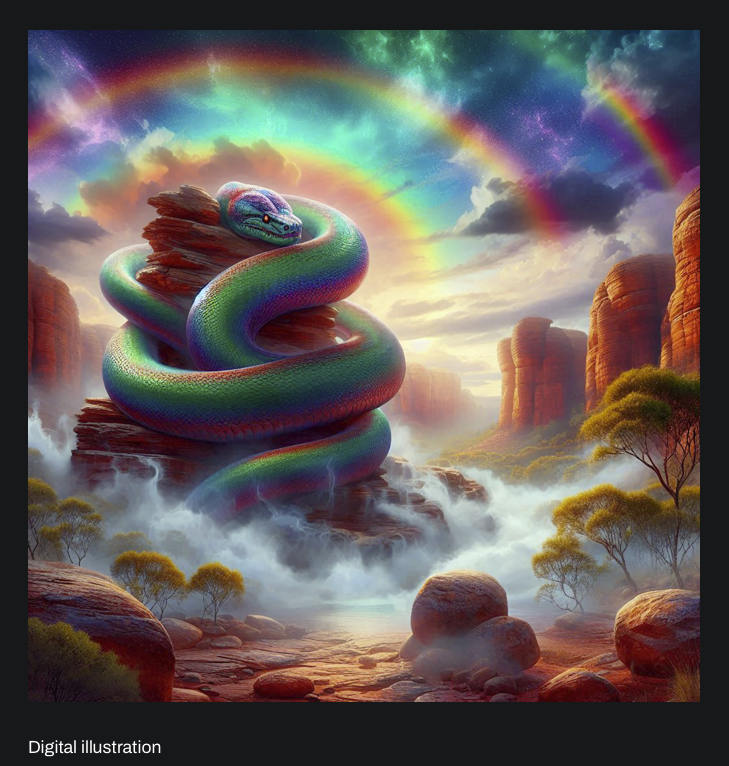
Digital Illustration on right: from ‘The Rainbow Serpent’ Feature Story
Sitakumari
And that brings me to what you are doing. You’ve heard about what Donna’s doing in Alabama. You’ve heard about what Steven and all our friends in Kenya are doing. You are building up to a very exciting celebration this year. It’s the 50th anniversary of NAIDOC, and we’re going to do something with Cùra Guardian within NAIDOC. Now for those who don’t know, NAIDOC is the annual celebration
of the indigenous cultures of Australia and the Torres Island Strait people.
Donald Rowlands
Yes, National Aboriginal Day of celebration, basically. That’s what it stands for.
Sitakumari
With this being the 50th year, we have to do something special.
Thank you for contributing. We are honoured that you shared the Dreamtime stories with Cùra Guardian. It means a great deal, as everybody else this evening and this morning is sharing these very precious stories. This is important in inspiring. particularly the next generation and where we go from here.
Don, thank you very much. I’m going to now bring in, we’ve got one final contributor, and that’s Hana Shono, who’s joining from Tokyo, Japan.

Photograph on right: Hana Shono, recently returned to Japan from Scotland, where she was Chair of UNA Scotland. She now continues her role as a UNA Ambassador.
Sitakumari
Welcome Hana, thank you very much for getting up as early as you have done, like Don, to be with us here today. And what I’m going to do is I’m going to take us back to the ‘Creation and Index’ part of the Cura Guardian website, because there is a new story there which connects with you under ‘Aether’. This has a strong cultural angle. It’s titled ‘Sakura’ and is about the Cherry Blossom Festival. Can you tell us a bit about it?
Hana Shono
Yes, sure. So, you know, as we fast approach April and the coming of spring, Sakura, the Cherry Blossom, is a very big topic. I’m Hana, I’m half Japanese, half Malaysian. My mother’s family is from the Goto Islands, just off Nawasaki. I’m currently living in Tokyo. As Gari said earlier, I moved to Tokyo from the UK, where I have been living for eight years, starting as an undergraduate in 2016 and just back since last year.

The early Sakura have already blossomed. They can be seen from January. I think they’ve just stopped blossoming now. The flowers are known worldwide, for their pink colour, their beauty, and they are just a reminder that we should
really enjoy life. It’s such a nice connection to nature and maybe even something that could be overlooked because it has become so popular. If you’re ever in Japan, you’ll notice that a lot of national holidays are called things like Greenery Day, Mountain Day, Marine Day and those days are exactly what they sound like – to appreciate greenery, to respect mountains, to celebrate the seas. So there is a very deep connection and respect for nature. And that can also be seen when the Sakura blossom. Many people take part in what’s known as ‘hanami’, which is Sakura viewing, just to take time to appreciate the Sakura, to look at them, celebrate their bloom and what they symbolize.
Sita Kumari
There’s something else that really touched me in this story, and that is that this festival is about celebrating the transient aspect of nature, that we need to appreciate it whilst it’s there, because it doesn’t stay forever.
Hana Shono
Yes, exactly. The impermanence of life. The Sakura only bloom for about one to two weeks from when you see the flowers until they fall. So that’s just a reminder that life is very is impermanent and should not be taken for granted. But they can also mean new hope, new life, vitality and the beginning of new things, because when they blossom, it marks the arrival of spring. So yes, it’s just interesting to think that their pleasing beauty is a reminder that we can’t stay stuck on the beginning of something new, that we do need to move on with life. Life does move on and we cannot remain in what is now the past.
Sita Kumari
That is such a powerful metaphor for what we need to do in terms of our world and the natural world in particular. So it’s inspiring, but there is a sad side to this story and we only came across it very recently, but we put it on the news part of the Cùra Guardian website. The festival this year has been cancelled due to what has been seen as disrespect from too many tourists! This is such an unfortunate situation for this beautiful festival and it conveys an important message for all of us.
Hana Shono
Yes, it’s a very big topic in Japan right now. We had elections on Sunday and that I think played quite a big role in how people voted. I think the biggest challenge with tourism is that many tourists who do come and visit don’t fully understand the rules and believe that they can behave the way they do at home and it’s absolutely fine. And while I think that is true to an extent, you know, it’s still important to realise that you are affecting people’s everyday lives, people do live here, work here. I think a lot of Japan is really advertised and perceived as a sort of theme park where people can just come and enjoy themselves, especially when everything is considered very cheap here. People are just taking, I think, a bit of an advantage of that. But it’s still important to realize, as I said before, that, you know, people do live here, they live their lives. Some people have been here their entire lives, they haven’t been outside of Japan, and it’s just important to respect that.
Sita Kumari
Hana, that’s the word that came to mind, respect. And I think that’s something that jumps out from all the stories we’ve heard tonight. It’s about respect. And I hope we can all carry these important messages away with us today.
I know the Sakura story goes back a long way and Hana, you have shared a beautiful painting with us for Cùra Guardian. Can you tell us about it?
Hana Shono
It’s been a tradition in Japan since the Heian period, which is a period between 794 and 1185 to participate in Hanami, which is the Sakura viewing. So it’s been something in Japanese culture for a very long time. No-one really knows when this was painted but they estimate it was between the years of 1832 to 34. It’s just a way to better see and understand how far back the tradition of Hanami goes and its cultural significance. This particular woodcut painting was by Tagawa Hiroshige. And he’s a very famous Japanese woodblock painter. In this painting, you can see there’s a Hanami viewing party that’s being led by two men on horses. I think it’s taken place in Asukayama Park, which is the north part of Tokyo. You can just see the number of people who are taking part in the viewing, emphasising the cultural significance that it has had since the 8th century.
Sitakumari
Which is why I thought it was a lovely story to finish on in our world tour, to finish on something so uplifting, but also to remind us how transient everything is and why we need to act and do things now. And I think really that brings us to the end of our contributions for today. I must thank you Hana, for taking the time and the trouble to join us all the way from Japan at such an early time in the morning. We hope this won’t be the first time we see you in in these events!
TO REACH THE DREAMTIME STORIES, CLICK ON LINK BELOW, SCROLL DOWN TO OCEANIA AND SELECT STORY.
TO REACH THE SAKURA STORY, CLICK ON LINK BELOW, SCROLL DOWN TO ASIA AND CLICK ON THE STORY:
Feature Stories
A Final Story from Scotland from Sitakumari
Having been around the world, I am going to close with a final story from our home base here in Highland Scotland, and which only recently has come to light. It is all about journeys and unbelievably amazing.
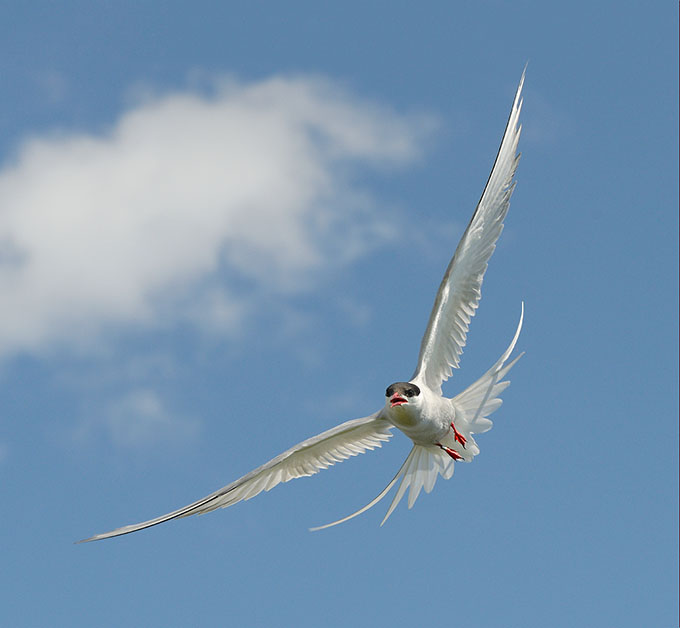
Close to the Heartstone office in Dingwall, on the edge of the A9, if you look at the right time of year, you will find a small bird, measuring about 30 cms in length and weighing approximately 100gms, nesting. This is the Arctic Tern, a bird with a migration path which is the longest known migration of any bird or animal. It is only recently that scientists have been been able to measure the distance it travels – from the Arctic to the Antarctic covering around 96,000 kms in 10 months! Its nesting grounds include Greenland and Iceland and, as we have discovered, by the A9 close to Dingwall! On its return journey from the Antarctic, it follows an S shaped pathway, and ends in the Arctic.

This is one of my favourite stories I tell as a dancer/storyteller in which I portray how it uses the stars to navigate on this incredible journey.
Which brings us right back to another of the real concerns about climate change, human activity contributing to this and its impact on the natural world. If you can’t see the stars, due to heavy pollution of the air as is happening in many parts of the world, you lose the ability to navigate and this has devastating consequences for the Arctic Tern and other birds like it, which live alongside us on this planet.

I would like to close with a photograph of myself on stage in a dance pose meaning ‘listening’. There has never been a more important time to hear all these messages in stories from the past from every continent and the new findings from the present, and for people across every background and culture to work together.
This event has been an incredible new journey and I would like at this point to ask Cllr Chris Ballance, the Depute Lead for Inverness City, who we are delighted to have with us at this event to say a few words to close. Chris, you have heard all the stories and joined us on this world tour from Montana across to Japan and now back in Scotland. Welcome.
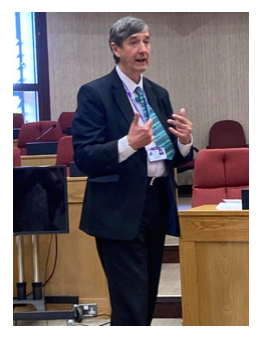
Cllr Chris Ballance, Depute Leader, Inverness City
Thank you for that honour, and if Don doesn’t mind, I would like to start by borrowing the Australian acknowledgement of the traditional owners of our world and their continuing connection with the land, the waters and community. And this event really has paid respect to the people and the cultures and the elders, past and present. So thank you so much for putting it all together.
It is all about the culture and the culture that we have in indigenous stories that tells us how we can live with nature. We are a part of nature and we have somehow or other seem to have forgotten that. But we’ve heard from Nuala, we heard of the power of the culture of heritage, Ada from Montana talked about how we carry our stories in our heart and they guide our hearts and that is so important. And from Chelsea, how we navigate our relationship with wildlife. The stories, the traditional stories, from across the world are so important and this is why Cùra Guardian is so important and the collection that is being created on the internet is a really important tool for us all to have.
We have our own stories here in Highland. We have the creation stories regarding the Cailleach, the old woman who created Scotland, and her daughter Bride or Bridget, and of course Angus, the sun god, who stays in the Tir na nÓg, the land of the ever young. I’m actually working on creating a small storytelling centre just on the edge of Loch Ness at the base of a sacred ancient hill and hill fort. I hope this will be a centre for storytelling because It is through traditional stories that we can learn how we coexist with wildlife, how we learn that we are a part of nature.
I strongly believe that change is coming. Don talked about how Aboriginal people in Australia cared for, cultivated the land for 60,000 years without any damage. We’ve managed to almost destroy it in 200 years and we need to change that. And that change is, I think, coming. I don’t quite know how it’ll come or when it will come, but I have absolute conviction that it will come, and I think the power of story is part of the driver, in fact, the main part of the driver of that change.
So thank you very much Sita and thank you so much for all the contributors. I’ve really enjoyed listening to this evening to everybody. It’s been a fantastic gathering of folk from right across, right around the world. And so from us here in Scotland, all we can say is thank you for putting it together and thank you very much for everyone for telling us your stories. Thank you.
Sitakumari
I hope you are all excited enough by what you have heard tonight to go to the website at www.curaguardian.com and read the stories we’ve talked about this evening. It remains for me to say thank you all for joining and having taken the time to be with us for this very first Cùra Guardian online event.
Thank you Dr. Gari Don and Councillor Kate Willis for opening it, all our contributors and Councillor Chris Balance for your thoughtful closing remarks. It’s time to say good night from here in Scotland. Thank you all for taking the time to be part of this amazing event and good night.
ALL DIGITAL ILLUSTRATIONS, DON ROWLANDS and SITAKUMARI PHOTOGRAPHS IN THIS FEATURE: ©Nick Sidle