

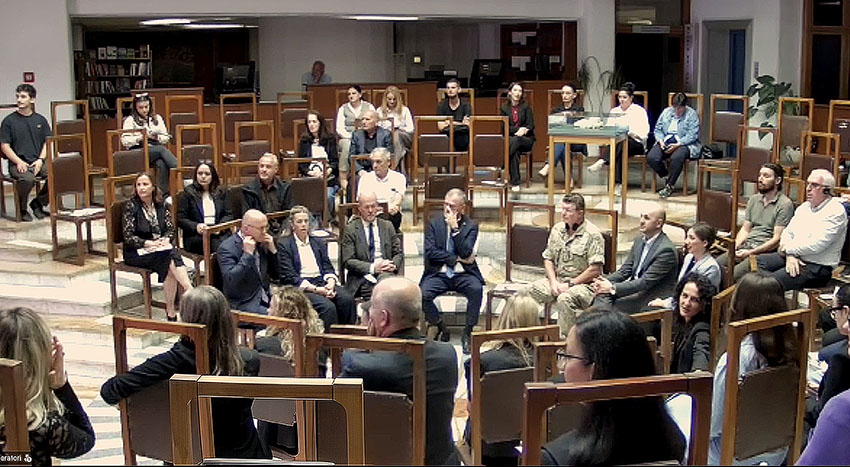
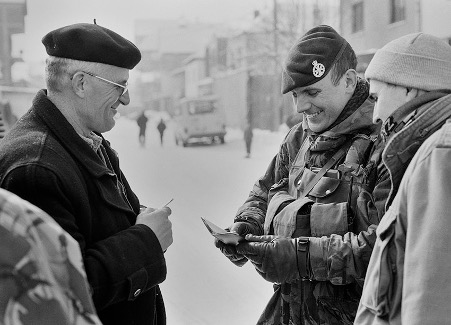
On June 12th 2026, a distinguished audience including Ministers, MP’s, Senior government officers and civilians came together at the National Library of Kosova in Pristina to connect with a similar distinguished audience at Manchester Central Library, including former NATO Secretary General Lord Robertson and General Sir Nick Carter and members of the Kosova diaspora in Greater Manchester for the launch of Phase 2 of the Heartstone project with the National Museum of Kosova. This will see the ‘KFOR and Kosovo +25’ photodocumentary take shape as a permanent 200-image exhibition at the Museum and Art Gallery in 2027 together with a further 400 image and story narrative historical archive. This will include accounts from soldiers of the KFOR countries who were there at the time and civilians in the story Some of these images were on display at the National Library for this event, which also included the first civilians who have been located from the images as part of this current phase, to add their stories 25 years later to this exhibition. This makes it not just a historic photodocumentary, but a story for today. Several of the special guests in both Manchester, UK and Pristina, Kosova spoke at the event presenting the significance of this exhibition in the context of past, present and future. (Photograph above from the photodocumentary: ©Nick Sidle)
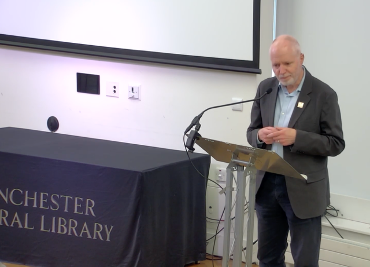
Left: Ivan Wadeson, Director Manchester City of Literature opened the event with a welcome to guests in Manchester and Pristina.
“I’m Ivan Wadeson from Manchester City of Literature. We manage the city’s UNESCO designation on behalf of Manchester Council, University of Manchester, Manchester Metropolitan University, and we coordinate the Festival of Libraries across Greater Manchester. So this event is 1 of 127 events and exhibitions that have been happening across Greater Manchester this week. So I’m not the reason you’re here. It’s Sitakumari and her team are the reason you’re here, and the amazing work you do. When we had a conversation about the work that Heartstone is doing with the Story Circles, with the exhibition, with the story from Kosova, I said, “Absolutely. We need this as part of Festival of Libraries. It’s such an important story that we need to tell and retell, and we need to keep connecting people with it.”
So if you haven’t come across the Festival of Libraries, it’s absolutely that idea that we work across public libraries in all 10 boroughs of Greater Manchester. We work with historic libraries, with specialist libraries like the Working Class Movement Library, Manchester Poetry Library, and we bring writers, artists, and communities together to celebrate why they’re so special. So it’s really thinking about libraries as creative and community hubs that serve people. And so a lot of what we’ve been doing and a lot of what Sitakumari is doing, in these very difficult times where there are people trying to spread hate, trying to spread division, putting a wedge between communities, it’s even more important that we bring people together, that we talk about what connects us, what makes us all human, and that we bridge any gaps that people are trying to exploit.
if you haven’t come across the Festival of Libraries, it’s absolutely that idea that we work across public libraries in all 10 boroughs of Greater Manchester. We work with historic libraries, with specialist libraries like the Working Class Movement Library, Manchester Poetry Library, and we bring writers, artists, and communities together to celebrate why they’re so special. So it’s really thinking about libraries as creative and community hubs that serve people. And so a lot of what we’ve been doing and a lot of what Sitakumari is doing, in these very difficult times where there are people trying to spread hate, trying to spread division, putting a wedge between communities, it’s even more important that we bring people together, that we talk about what connects us, what makes us all human, and that we bridge any gaps that people are trying to exploit.
Thank you very much to the Lord Mayor, and Lady Mayor of Rochdale for being here. We really appreciate your support. The Festival of Libraries is about local communities, but it is also international. As a UNESCO City of Literature, we are connected to 62 other cities of literature in six continents, in 40 different countries. Then there’s a wider UNESCO Creative Cities network of 400 cities, and we all share how we work, we collaborate, we make each other stronger and better. So building this link with Kosova National Library couldn’t make us happier!
Building this link with Kosova and the National Library, couldn’t make us happier.
Thank you all for being here, and a huge thanks to Sitakumari and the team at Heartstone for bringing this to us.”
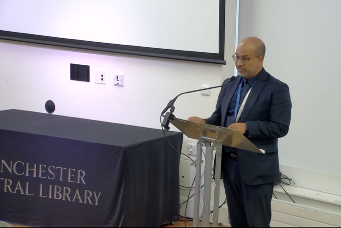
Deputy Lieutenant Muzahid Khan followed with his address:
“Good afternoon, everyone. It’s really a great pleasure for me to welcome you all to Manchester Central Library as part of Manchester’s Festival of Libraries. Today marks the launch of Phase two of this important international project between the National Museum of Kosova and the National Library of Kosovo, and our partners here in the United Kingdom, centred around the powerful photodocumentary, ‘KFOR and Kosovo + 25’. Originally created by photographer Nick Sidle in the year 2000 to 2001, he was embedded with the British KFOR regiments over the course of that year. The exhibition documents a unique moment in history. It tells the story of peacekeepers helping to bring safety, stability, and security to a country emerging from conflict.
“Good afternoon, everyone. It’s really a great pleasure for me to welcome you all to Manchester Central Library as part of Manchester’s Festival of Libraries. Today marks the launch of Phase two of this important international project between the National Museum of Kosova and the National Library of Kosovo, and our partners here in the United Kingdom, centred around the powerful photodocumentary, ‘KFOR and Kosovo + 25’. Originally created by photographer Nick Sidle in the year 2000 to 2001, he was embedded with the British KFOR regiments over the course of that year. The exhibition documents a unique moment in history. It tells the story of peacekeepers helping to bring safety, stability, and security to a country emerging from conflict.
But beyond this military story lies something even more powerful, the human story. It is a story of ordinary people rebuilding their lives in extraordinary circumstances. A story of resilience, courage, and hope. A story of communities overcoming division and looking towards a better future. These photographs remind us that regardless of nationality, faith, culture, or background, we are human beings first. They remind us of the importance of challenging prejudice, intolerance, and hatred in all its forms. They remind us that every story has different perspectives, and that understanding begins when we listen to one another.
This exhibition is therefore not only about history, it’s about welcome, empathy, and kindness. It’s about refusing to turn away when others are in need. In 1999, the people of Manchester demonstrated those values by welcoming families fleeing this conflict. Some of those who built new lives here are with us today, and we are honored by their presence.
The next phase of this project will see the development of a permanent exhibition at the National Museum of Kosova, incorporating the voices and experiences of those lives that are captured in the images.
Alongside this, Story Circles will be established in Kosova, ensuring that the lessons and messages of these stories continue to inspire future generations.
Stories matter. We all know that. We all have our own personal stories. Throughout history and across every culture, stories have helped us understand one another, preserve our memories, and build empathy. Libraries have always been guardians of those stories, making this historic venue a particularly fitting place for today’s gathering.
We are also delighted to be joined by friends and partners from across the world. I extend a warm welcome to Donna Beisel, Director of the Rosa Parks Museum in Alabama, Don Rowlands, Aboriginal Elder and keeper of the Dreamtime stories in Queensland, Australia, and Nita Tilney, who will be leading the first Story Circle in Outback Australia. Though their work, and through the growing Global Story Circle network, these important conversations are reaching communities across continents.
This is an important moment at a time when division and misunderstanding can too often dominate public discourse. Projects such as these remind us of our shared humanity and our collective responsibility to build understanding, compassion, and peace.
And finally, I’d like to thank all those who have made this project possible. Manchester City of Literature, Read Manchester, the Ministry of Culture of Kosova, the National Library of Kosova, the National Museum of Kosova, Donna Beisel and the Rosa Parks Museum in Alabama, Don Rowlands and Nita Tilney in Queensland, Australia. So thank you all for being here, and for supporting this remarkable project, and I wish you an inspiring and thought-provoking afternoon as we also converse a little bit later after the formal aspect of this presentation.
Of course, it’s my pleasure now, really, to welcome a very special speaker, Lord Robertson was the NATO General Secretary at the time of the photodocumentary, and someone who assisted with access and staging in 2001 and with all the current stagings in the period of the 25thanniversary of KFOR in Kosova. So let’s show a warm reception to Lord Robertson. “
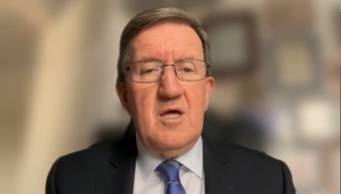
Lord Robertson, NATO Secretary General at the time the photodocumentary was produced, said:
“Thank you very much, Deputy Lord Lieutenant, and thank you to Manchester’s Central Library and all of the others who have made this possible, as well as to the National Library of Kosova, whose representatives are watching this today. Their generosity has been particularly valuable in promoting this exhibition.
The conflict in Kosova in 1999 is engraved on my heart and on my own political history. The liberation of Kosovo was one of the happiest days of my life, and my first visit there after the liberation was a significant moment in my whole long political career. General Carter, who is also on the line today, was the Commanding Officer at the time I was visiting.
This exhibition and these remarkable photographs and stories that have been so expertly researched and curated, along with all of the people identified in them, sum up one of Europe’s most memorable periods since the end of the Second World War, the stopping and the reversing of some pretty horrible ethnic cleansing in the region. Here is projected not just a military and diplomatic victory, although it certainly was, but we have real people in real lives, in real surroundings, with their military protectors and liberators enjoying, in these photographs, a freedom that they thought had been stolen from them forever. The exhibition is heartening, inspiring, it’s educational and historic, and all of the people of Kosova, indeed all of the people of Manchester and beyond, have much to learn from seeing this exhibition and understanding what the exhibits and the photographs actually say, because it does call out the very clear message that good can triumph over evil, and that Europe can intervene to protect lives and liberty, and that people of all ethnicities can, with help, live together. That is what the modern Kosovo actually is today. So I commend the exhibition and thank you all for coming here today and for supporting it.”
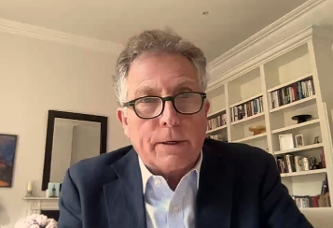
General Sir Nick Carter, Commander of the Royal Green Jackets at the time, one of the regiments included in the story, followed with the following statement:
“Thank you for including me in this event, and thank you to the Festival of Libraries for including this very important exhibition in your broader exhibition. It’s very powerful, and I have to say, I really do commend the work that Nick Sidle did during that period when we were all there. I spent seven months as the commander of the Royal Green Jackets responsible for Pristina from more or less the end of 1999 through to the middle of the year 2000. I have very special memories of Kosova and its people, particularly New Year’s Eve 1999/2000, when, of course, you’ll remember if you’re old enough, that we were all worried about the millennium bug and associated issues. But I remember being on a platform in the centre of Pristina, where there were probably 40,000 Kosovar Albanians assembled, many with their AK47s. And when the clock struck 12, most of them raised them above their heads, and the fireworks were spectacular as the tracer burst above our heads. Of course, it was that wonderful sense of euphoria.
But I think this Kosovo conflict, and of course this exhibition, have become really so resonant these days. Because what Kosova proved was that it is possible to achieve international consensus on a difficult issue, and particularly from a European perspective. It reminds us that it’s possible, even in a country which at the time, as Lord Robertson said, was riven by interethnic conflict.
The story that Nick Sidle tells therefore resonates today, particularly in the light of the conflicts that we see unfolding, both in Ukraine and the Middle East. For it reminds us, I think, that the nature of war never changes. It’s always about a violent interaction between human beings. This story, though, brings to life in a clear and honest way the moment when I think, despite the darkest of times, the human spirit found a way of providing hope to shattered communities and restoring peace. It also brings to life the positive and neutral role that soldiers play as peacekeepers, a role that I fear will be continually needed in an ever more conflicted world.
So I hope you will all be moved by the exhibition when you get a chance to see it in a moment, and I hope that it can fulfill its potential to make a difference in what is an ever more complex, dynamic, and unstable world, and I commend it to you. “
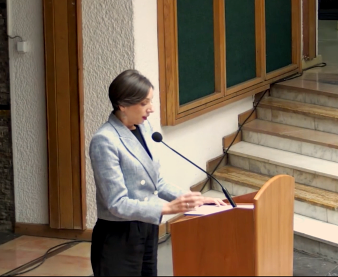
Joining live from the Kosova National Library, in Pristina, Acting Deputy Minister of Culture and Tourism in the Republic of Kosovo, Ms. Nora Arapi Krasniqi followed:
“Dear Lord Robertson, former NATO Secretary General, dear Mr. Bislim Bislimi, General Secretary of the Ministry of Culture and Tourism, dear Ms. Blervina Rrugova Gaxha, Director of the National Library in Kosovo, dear Ms. Vjollca Aliu, Director of the National Kosova Museum, dear Mr. Ivan Wadeson, Director of Manchester City of Literature and Festival of Libraries, dear Mr. Muzahid Khan, Deputy Lieutenant of Manchester, to Ms Sitakumari, Director of Heartstone, dear representatives of the local and international institutions and ambassadors, dear participants, it is a special honor today, as we mark the 27th anniversary of the Kosovo liberation, to be together at this so significant exhibition, which invites us to reflect on one of the most determining periods in our new history. Frequently, when we speak of the history and of a major political event, we have a tendency to look at historical turns through figures, official documents, or political decisions. However, the true history of a people is preserved in memory of people, in their experiences, challenges they went through, and the hope that kept them in the hardest moments.
The ‘KFOR and Kosovo +25’ exhibition, which is a continuation of the project started in 2024, provides us exactly this human perspective. It is not only a photographic document of a certain historic period, but it is a live testimony of a beginning of a new chapter for Kosova, told through an eye of a photographer, Nick Sidle. Photographs done in 2000-2001 bring us back to a time when our country was leaving ruins of the war and was taking the first step towards reconstruction, stability, and development. This exhibition reminds us that freedom and peace is not given forever. They are a result of sacrifice of our people, of its unstoppable resistance, and of unwavering support of our international allies.
On this important anniversary, we express our deep gratitude to NATO, to the KFOR Mission, who played a crucial role in ensuring security and providing conditions for building democratic institutions in the Republic of Kosova. The contribution of officers and soldiers from allied countries remains important for our story of success and building peace and development. At the same time, the exhibition tells us that the ties built in the hardest time haven’t diminished over time. On the contrary, they continue to be strengthened through cultural cooperation, common memory, and values that we share with our international partners.
What makes this project especially important is the fact that it doesn’t stop only on documenting the past. Through the continuous work of our institution, cooperation with the mentor institutions to identify the persons in those photographs and return of their stories to the collective memory, we are building a strong bridge between generations, between the past, the present, and the future.
I would like to express my deep gratitude to the Heartstone Organization and Nick Sidle, photographer, Kosova National Museum, Kosova National Library, and all partners in this project, who as co-founders and in this story, have contributed to bring this exhibition before the public.
Dear participants, on the day when we mark the 27th anniversary of the Kosova liberation, this exhibition invites us to reflect on the value of peace, importance of solidarity, and our responsibility to retain historical memory as a foundation of our future. I invite you to look at those photographs not only as documents of the past, but as a testimony of our common journey towards a democratic, free, and developed Kosova. Thank you.”
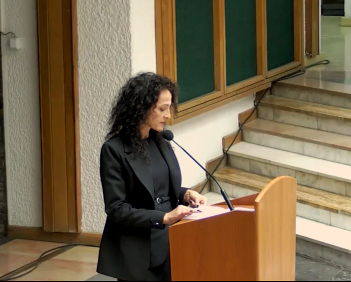
Director General of Kosova National Library, Ms. Blerina Rogova Gaxha, followed with this address:
“Dear Deputy Minister of Culture, Arapi Krasniqi, dear Secretary General of Ministry of Culture, Mr. Bislimi. dear Mr. Ivan Wadeson, dear Deputy Lieutenant Muzahid Khan. dear Lord Robertson. dear Director of the Museum, Ms. Aliu, dear representatives of local institutions and diplomatic representatives in Kosova. dear guests, ladies and gentlemen, it is a pleasure and honor for us, to me, on behalf of the Kosova National Library, to wish you welcome to this event. The 12th of June is a historic day and a live memory of a great return in our lives and in the life of our country. On this particular day, the exhibition invites us to, beyond the official narratives, to focus on human experiences, individual stories, and on the common memory that has shaped us as society. The exhibition, ‘KFOR and Kosovo +25’ brings a visual story on the post-war Kosova, a story which brings to Kosova through the human dimension. The photographs taken by Nick Sidle is a documentation and testimony of daily life. They are testimony of hope, of insecurity, and of reconstruction of a new time in our history. They remind us that history not always is what is written in books. History is also what is experienced in calm, in peace, and silence. History is what is experienced as you return home, in waiting, in small meetings that carry the great weighing of a time. They remind us that an important part of this history has been frozen in photographs, thus also freezing time on them. For us, as an institution it is of utmost importance that those stories become part of the dialogue, that they are exposed. The Kosovo National Library is and aims to be a space where documents, memories, and society get together, a space where history is preserved, but also interpreted, reviewed in the light of time.
This project, implemented in cooperation with the Heartstone organisation, in partnership with the Ministry of Culture, with the Kosova National Museum, is an example to show how national, international, and cross-institution cooperation can provide sustainable bridges of understanding and reflection.
The specialty in this exhibition is that it continues to be built and to be recreated every day. Identification of civilians and militaries in the photographs and inclusion of their personal stories gives this project a new dimension, the return of the human voice into history. The fact that this exhibition is presented on the 12th of June, on the Kosovo Liberation Day, makes this moment even more significant. This is a day, beyond the memory, to reflect on our journey as society at a time when the world continues facing conflicts and similar challenges. Exhibitions like this call us to stop, think, and reflect on the importance of peace, on the role of the memory, and on our responsibility to preserve and to follow it to the future generations. Thank you for your presence and for supporting this initiative.”
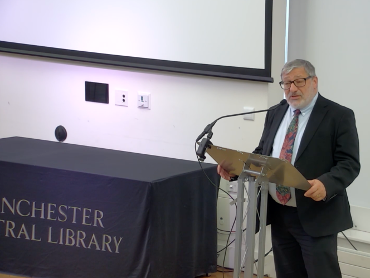
Rabbi Warren Elf, Chair of the Faith Network for Manchester, who have been one of the main partners for the National Heritage Lottery Fund project which has brought the ‘KFOR and Kosovo +25’ exhibition programme, to the Greater Manchester region, followed with this address:
“The Faith Network from Manchester, which is an interfaith group representing and pulling together hopefully all the different faiths, and some people not of faith as well, in Manchester together for a lot of community cohesion work and to develop understanding. We’ve had a partnership with the Heartstone for, it’s probably almost 10 years now, I think, and it’s always a pleasure to work with Sitakumari and the programs that she brings, the story, The Heartstone Odyssey, and the work with schools and other groups, which is so important, especially challenging prejudice and hatred, especially when things have been going on in our society – in Northern Ireland and Belfast, after Southport, lots of different things here in this country.
It’s been a pleasure and a privilege to be involved in the work of bringing the exhibition ‘KFOR and Kosovo +25’ to Britain, especially to Greater Manchester. We were present at the opening in Rochdale at the very start of the year, and also earlier in Manchester.
If you look at the images, just sometimes it’s the expression on a face, it’s a gesture, it’s something reaching out, either members of the peacekeeping force reaching out to the children or families and vice versa. You can see the importance of reaching out and striving and maintaining the peace, of developing the relationships around everything that has been so important to overcoming prejudice, overcoming hatred, overcoming everything that we don’t understand about each other. And in so many ways, it’s when people don’t understand, when people respond to messages of hate, initiatives encouraging hatred, encouraging people to not seek to understand ‘the other’, that actually that’s where we need to do things. So the Faith Network from Manchester are very much about interfaith dialogue on all sorts of topics. Next week we have one looking at supporting refugees and what can we do to make sure that their welcome is appropriate and proper into this great city. We cover all sorts of religious and non-religious issues. We take people round to different venues, faith buildings, to try to teach about different faiths, to get people to understand. And the most important message for all of us, I think, is when we’re standing together, up to eight or nine faiths together on the same platform in front of a classroom, whatever it is, and saying, “We actually share so much. Our ideals, our values, our humanity is what binds us and holds us together.” And that can overcome any of the hatreds, any of the prejudice, and we need to emphasize that. Where we have differences, there are things we can learn from each other and celebrate as well.
So it’s a real privilege being able to be here yet again with Heartstone obviously and say, “Thank you, Heartstone, for the work you’re doing. Thank you, Sitakumari, and all your team.” I can wholeheartedly recommend the exhibition again, and let’s keep spreading the word.”
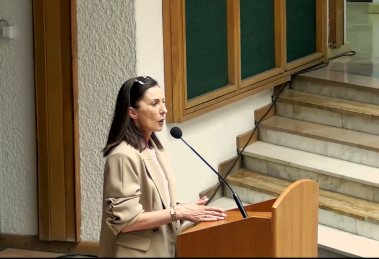
Director of the National Museum of Kosova, Ms Vjollca Aliu, was instrumental in bringing the exhibition to the Museum working closely with the Heartstone team and Nick Sidle, the photographer. She said:
“Dear Deputy Minister, Ms. Krasniqi, dear Secretary, Mr. Bislimi, dear Lord Robertson, dear participants at the Kosova National Library and in Manchester. Yes, it’s true, supported by the Ministry for the first time, the exhibition took place at the Kosovo National Museum when we marked the anniversary of the Liberation Day, which, as the previous speaker said, besides presenting an important moment, we deemed it as the return moment regarding the liberation of the country and establishment of our democratic institutions.
The biggest thanks, I think, belong to, on this day, to peacekeeping forces who liberated the country and provide peace and stability. I would like to thank representatives of diplomatic offices who are here present today and all other participants in the media.
But above all, the Ministry of Culture, without the support of whom, this exhibition and this program wouldn’t be possible.
It also marks another cooperation between our two institutions, the museum and the library, and the institutions in Manchester, especially emphasizing Heartstone. Thank you very much and happy Liberation Day. “
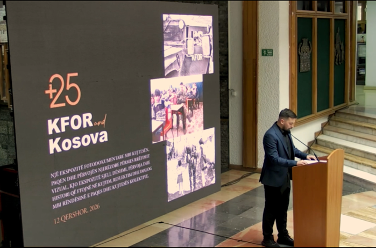
Riad Haxha, one of the two Heartstone team members who are locating and interviewing the civilians from the photographs, brought the statement from Ms Florie Berisha, Headteacher of Burice School, one of the most memorable photographs in the exhibition. Riad, pictured above and at left in front of one of the images from the exhibition in which Ms Berisha is included, said:
“Dear participants, it is a pleasure to be with you today here. My name is Riad Haxha, and in this project, I assisted in analysing and localising the photographs and the persons who appear in them.
In my opinion, the importance of this exhibition is great because through the images, you can see the reality of Kosova in 2000 when people were devastated by the war. It was not a war as it is presented in articles or headlines as the Kosovo War 1998, 1999. This war had started centuries before, and it had gone through generations, leaving big consequences for the Kosova people, be it on the Albanian or minority communities. In the images, you can see faces of people when they, for the first time, see the KFOR soldiers, often sad because the soldiers, to them, were no longer the protection of territory and population, but a violent aggressor who would violate, kill, and rape. But in the exhibition images, you can see that over time, the KFOR soldiers started to look as they should be – peaceful, protector, and kind to people.
Not wanting to dwell long on it, I would like to thank Mr. Nick Sidle, Director of Heartstone Sitakumari, Director of Manchester Aid to Kosovo Pamela Dawes, and the Director of the National Museum, Ms. Vjolcca Aliu, for the trust in me to work with them in this important project. Also, I would like to thank all those persons who found time to be interviewed and to contribute who are also on the images – Mr. Shaban Vllasiu, Mr. Agim Neziry, Rafet Berisha, and Ms. Florie Berisha.
Ms. Florie Berisha, wanted to be with us today but due to serious health issues, she could not attend. Nevertheless, she gave me a statement which she wrote, and she would like me to read for you.
Florie Berisha, the principal:
“Dear participants, with the greatest pleasure, I’m writing this speech. I would like to attend this exhibition, but due to some health issues, I cannot be close to you today. My name is Florie Berisha, and since 1992, I worked as a teacher of Albanian language. Most of the time in education, I spent at Ekrem Çabej in Burice Village, where in 1996, I was appointed the principal till 2026 when I retired.
In 1998, 1999, because of the war, our school was burnt and half of it had been destroyed. For a long time, we taught even in the woods nearby the school. Since Burice is a mountainous village, that was the only solution. During the war, there were many attacks by the Serbian army, so we often were compelled to leave, being at great danger for our lives and the lives of our students. After the war, the school was in a very difficult situation, so we were compelled to ask for help from various organizations. After the war, the situation was unstable, and our municipality was not capable of assisting us.
That’s why we contacted KFOR, which was located in Sekiraca Village. We encountered the British KFOR and Captain George Clegg, who promised that he would do his best to reconstruct our school. They renovated almost everything – the floors, the roof, and the walls. Together with some of our staff members, we almost reconstructed the whole school building. British KFOR and Captain George were positive and very close to the children. After the work, we organized a festive day where children danced, sang, and presented comical pieces. At the time, most of the population was unstable, not only psychologically, but also physically.
This assistance was of great importance for us. As I said in my interview earlier, these images and this exhibition are of utmost importance for me and for Ekrem Çabej School in Burice because this assistance will always remain part of the- history of our school.
In this speech, I would like to once again thank all KFOR members for their assistance, the photographer, Nick Sidle, and the entire staff of the exhibition who brought this story to life. Let this exhibition serve as a memory that humanity should always be there with us if we want to help others when they are in need. The British KFOR showed how important the good work can be. Since dozens of generations were educated in that school, they helped to reconstruct the building. Today, we can thank them by showing their work. Thank you. “
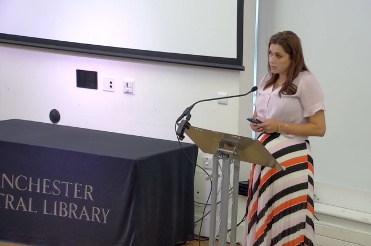
Besarta Shurecci is now Co-Director of Eagle Bee, the organisation representing the Albanian community in Greater Manchester. She was evacuated to Manchester at the time of the 1999 war and remembers the period well. She gave the following statement:
“Looking around the exhibition and seeing these pictures brings back memories of the Kosova War in 1999, of my own experience. They remind me not of what I saw, but also what I felt. I was 12 years old, living in a small village in Kosova. As the conflict intensified, my family and many others spent our days and nights sheltering in basements. During the day, my siblings, cousins, and myself, we would go into the garden to get some fresh air and make the most of what seemed normal childhood while being frightened and living in fear. At that age, we were counting days, if not hours, wondering when Serbian forces would arrive and what our fate would be.
One day in March, a Serbian military helicopter flew incredibly low over our village. It was so close that we froze where we stood. I remember feeling completely helpless and vulnerable. We knew we were being watched, and also we knew we were no longer safe. Then a few days later, something changed. One evening, while I was watching the TV with our family, we heard a loud explosion, and we thought we were being attacked. But as the TV informed, a breaking news, NATO had intervened. In fact, the explosion was the army reserve in our town being struck.
I remember the silence in the room, and for months, we felt forgotten. We had felt powerless, yet in that moment, we realized a great power had chosen to intervene. NATO was on our side. For many Kosovo Albanians, including myself, at that moment brought hope. We still feared what was ahead. For the first time, we felt that someone was looking out for us. That hope was quickly tested. A few days later, before dawn, my mother woke me up and simply said, “It’s time to leave.” The entire village gathered near the mosque. Serbian forces, armed with guns and tanks, ordered Kosova Albanians to hand over their money, their valuables, and their identification documents. We obeyed, and we were forced onto trains leading to the Macedonian border. I remember the uncertainty more than anything. Long queues, families asleep in makeshift tents, crying children. No one knew where they should go next or whether they would ever see their homes or their loved ones that they had split from. When Macedonia eventually opened the doors to the Kosova refugees, we were taken by buses to refugee camps and in this camp, we arrived, and the British forces were setting up tents and welcoming the families. Their kindness, patience, and respect left a lasting impression on me. After months of fear, that made us feel safe, and for the first time, soldiers represented protection rather than danger. So my perception of the military changed completely. Soon after, my family was offered refuge in the United Kingdom.
We arrived in Manchester, and we were welcomed with warmth, compassion, and we were being housed in Stockport, along with 20 other Kosova families. Stockport marked the beginning of a new life. Of safety, opportunity, and hope. Today, I’m a mother of three. I studied at the University of Manchester, and now I help lead the Eagle Bee Foundation, a representation of the Albanian community in Greater Manchester, which we strive to help and create positive change. When I look back, I often think how different my life could have been.”
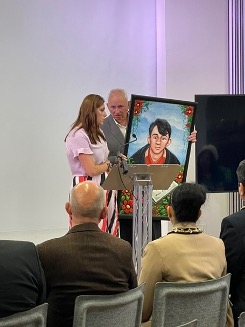
Following Besarta’s presentation, perhaps the most moving part of the event was the unexpected donation to the exhibition by Osman Caka, now resident in Greater Manchester, of a painting of his son, aged 17, killed during the Kosova War. It will be a treasured contribution to this exhibition.


